The 5-1 volleyball rotation is one of the most widely used offensive systems in club, school and college volleyball. One setter runs the offence in all six rotations, and five other players hit, block and pass. This guide shows how the 5-1 volleyball rotation works, what changes when the setter moves from the back row to the front row, and how to practise it.
What does 5-1 mean in volleyball?
The name counts the players: five attackers and one setter. A 5-1 lineup has one setter, one opposite hitter (the "opposite"), two outside hitters and two middle blockers. The opposite stands directly across the court from the setter. When the setter is in the back right (position 1), the opposite is front left (position 4). Because of this, the setter and the opposite are never in the front row together, and never in the back row together.
How the 5-1 rotation works
Rotation is clockwise. Each time your team wins the serve back, every player moves one spot: 2 to 1, 1 to 6, 6 to 5, 5 to 4, 4 to 3 and 3 to 2. The player who arrives in position 1 serves. After six rotations everyone is back where they started. Once the ball is served, players can move, so the setter runs to the target near the net, between positions 2 and 3, and the hitters spread out to attack.
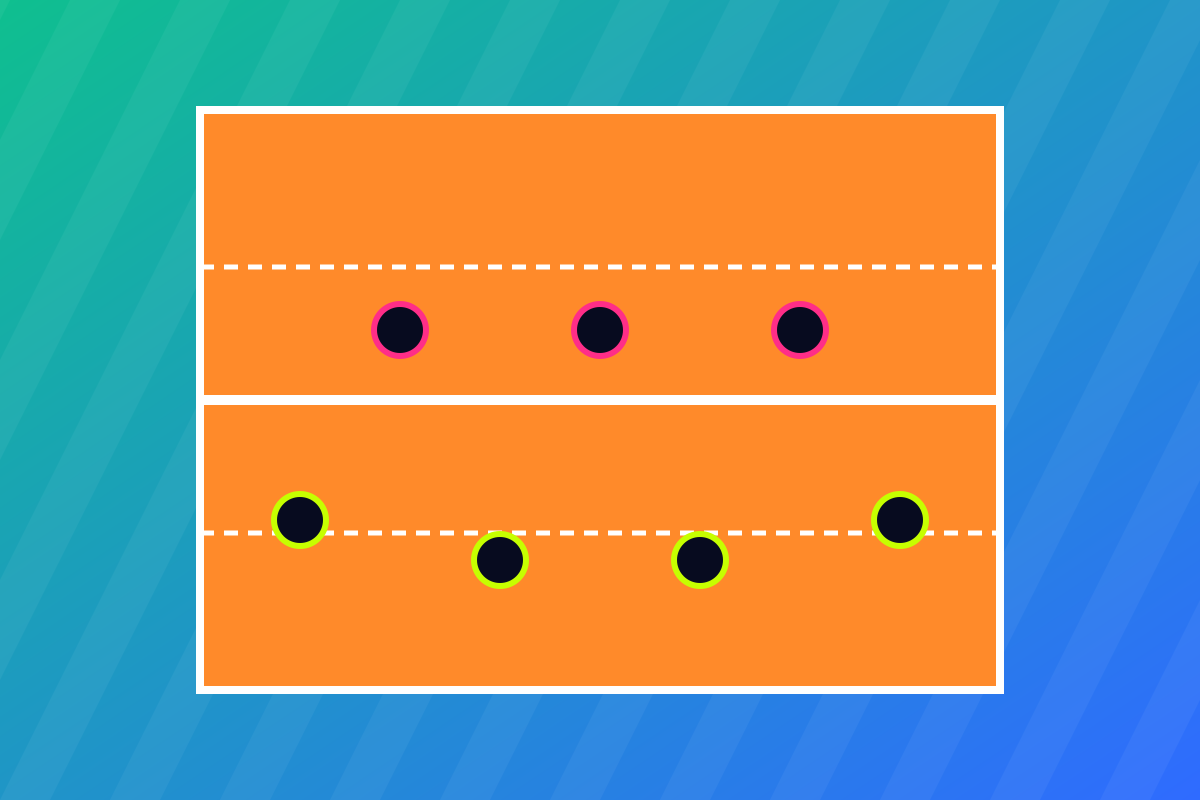
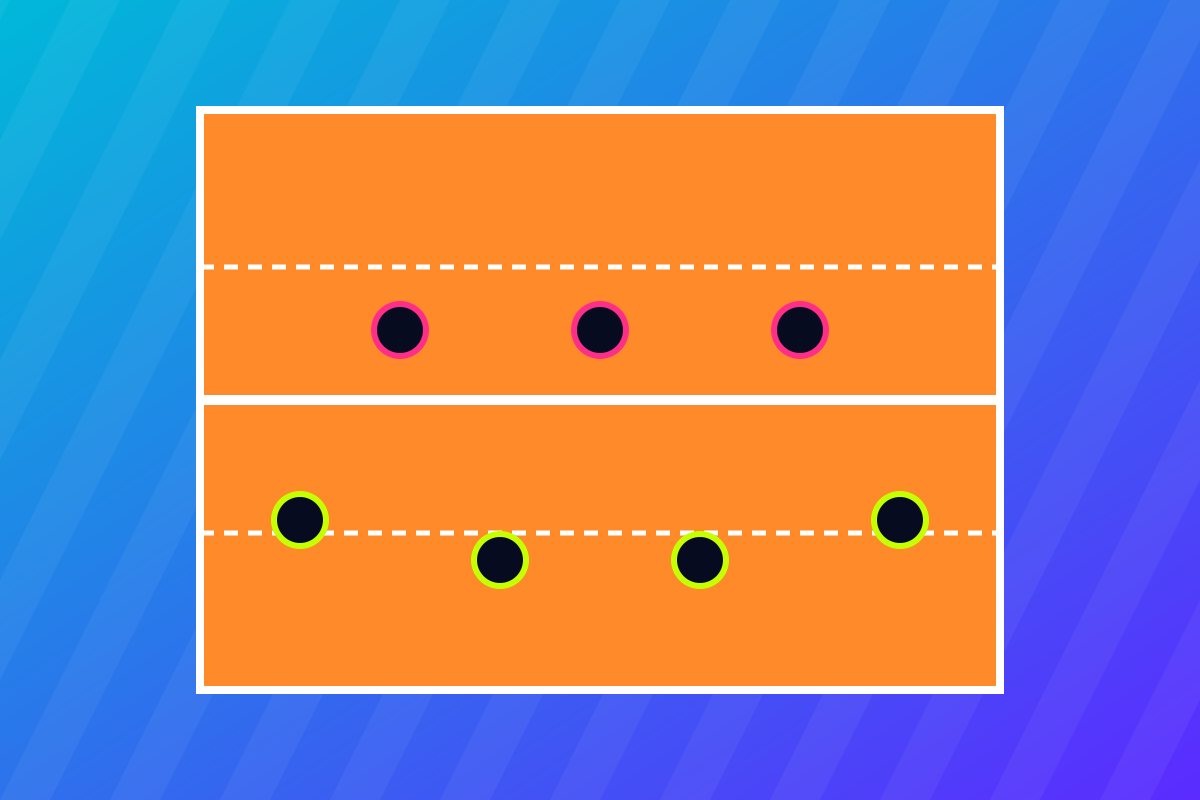
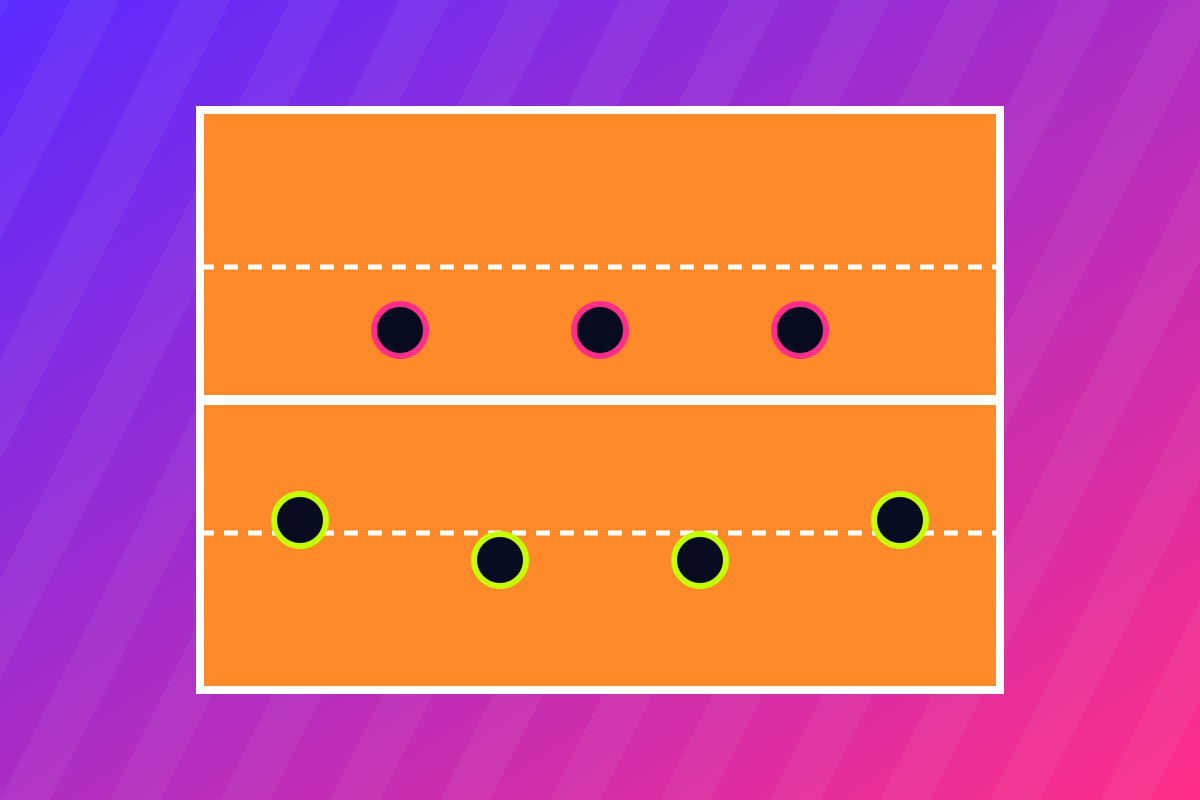
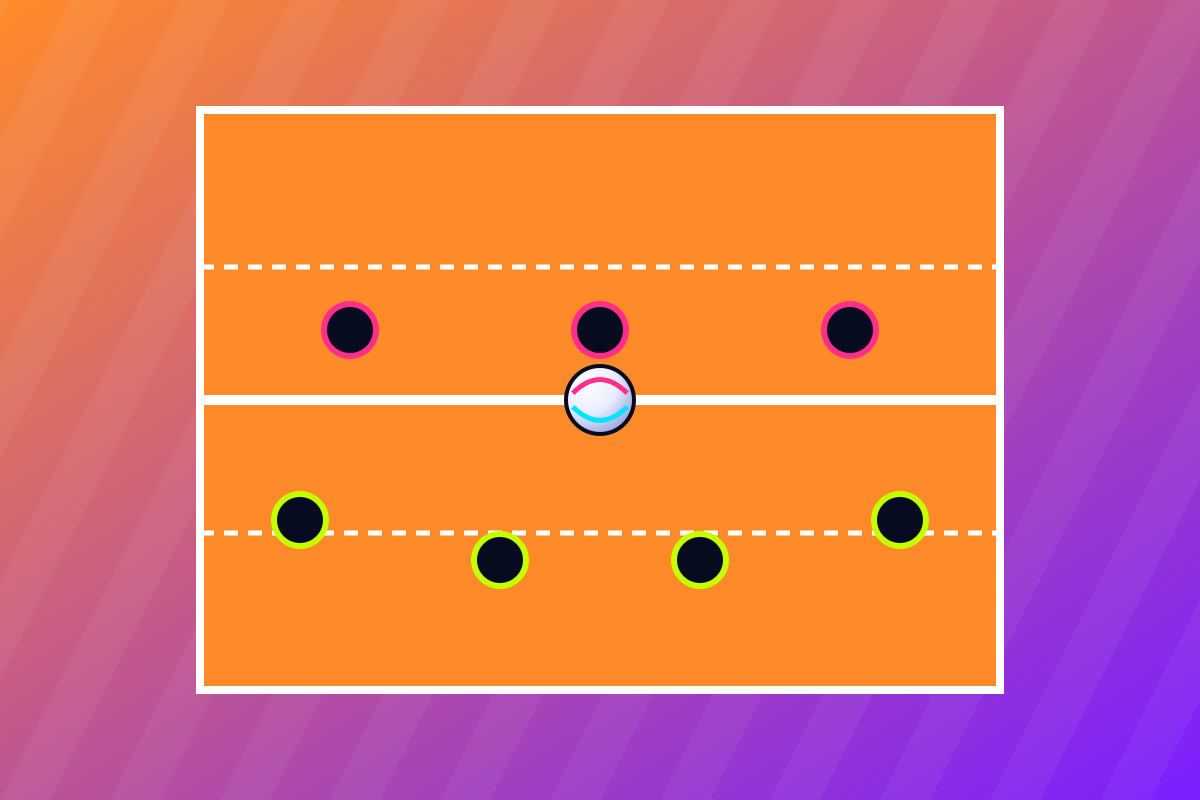
The six rotations (diagram)
Rotation numbers vary between coaches. Here, rotation 1 has the setter in position 1, and the next five follow clockwise. The net is at the top of each diagram, and the pink circle is the setter (S). Other labels are OH (outside hitter), MB (middle blocker) and OPP (opposite).
Most teams also use a libero, who replaces a middle blocker when that player rotates into the back row. The libero cannot rotate to the front, so the middle returns to the court at the net.
Setter in the front row vs back row
| Rotation | Setter at | Setter row | Front row (4, 3, 2) | Front-row attackers |
|---|---|---|---|---|
| Rotation 1 | Position 1 | Back | OPP, MB, OH | 3 |
| Rotation 2 | Position 6 | Back | OH, OPP, MB | 3 |
| Rotation 3 | Position 5 | Back | MB, OH, OPP | 3 |
| Rotation 4 | Position 4 | Front | S, MB, OH | 2 |
| Rotation 5 | Position 3 | Front | OH, S, MB | 2 |
| Rotation 6 | Position 2 | Front | MB, OH, S | 2 |
When the setter is in the back row (rotations 1 to 3), all three front-row players can attack, so the offence has three options. When the setter is in the front row (rotations 4 to 6), the setter becomes a blocker and an occasional attacker, but only two front-row players are true hitters. Many teams adjust their play-calling in those rotations, for example by running a quick middle attack and a high outside ball to keep the block guessing.
Why teams choose the 5-1
- One decision-maker. The same hands set every ball, so tempo and timing stay consistent.
- Specialists. Hitters hit and the setter sets, so nobody is asked to do a job they do not need.
- The opposite. A right-side attacker and blocker who often takes on the other team’s best hitter.
The trade-offs are real. You need one reliable setter who can also block and defend, and you need a backup plan if that player is injured or off form. Teams without a strong setter sometimes use a 6-2 volleyball rotation instead.
Practise the rotation
Use our volleyball rotation planner to see the clockwise movement. Press Rotate six times and watch the setter travel around the court. To brush up on the numbers, read volleyball positions explained, and check basic volleyball rules for how rotation order is enforced at the serve.
Common 5-1 mistakes
- Rotating the wrong way. The rotation is always clockwise.
- Forgetting to rotate after winning the serve back.
- A setter who drifts and arrives late to the target.
- Standing out of rotational order when the ball is served.
FAQ
What does 5-1 mean in volleyball?
It means five attackers and one setter. The single setter plays all six rotations, supported by an opposite, two outside hitters and two middle blockers.
Which way do you rotate in volleyball?
Clockwise. Each player moves one position (2 to 1, 1 to 6, 6 to 5, 5 to 4, 4 to 3, 3 to 2) when their team wins the serve back.
Where does the opposite hitter stand in a 5-1?
Directly across from the setter, so they are never in the front row together. The opposite is in position 4 when the setter is in position 1.
Does the setter hit in a 5-1?
In the front row the setter can attack, usually with a tip or dump on the second contact. In the back row the setter does not attack.
What is the difference between a 5-1 and a 6-2?
A 5-1 uses one setter all the time. A 6-2 uses two setters, and whichever one is in the back row sets, so there are always three front-row attackers.